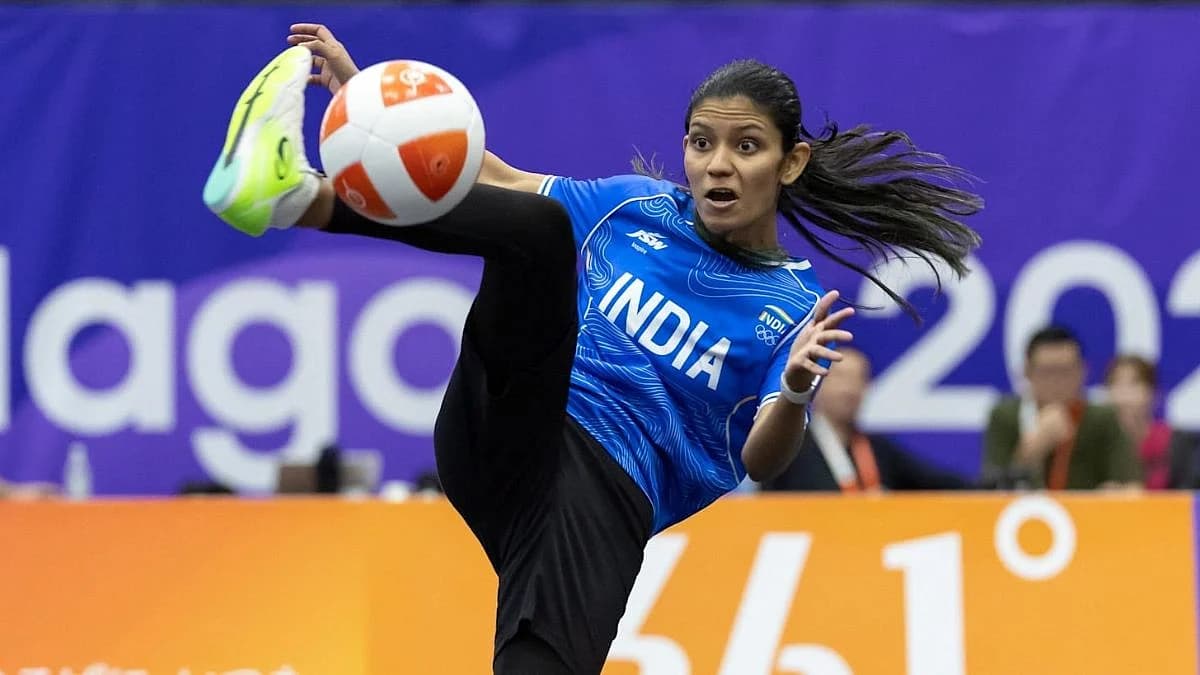
Quimcy Joaquim Dsouza lost the women’s singles teqball semifinal to Indonesia’s Sumaya with a score of 1-2 at the Asian Games 2026. Despite the loss, Dsouza secures a bronze medal match spot. Her partner, Mohamed Anas Imran Beg, also qualifies for the mixed doubles bronze match, ensuring India’s continued presence in the medal round for this emerging Olympic discipline.
Key Takeaways
- Medal Contention: India retains two pathways to bronze medals in teqball, confirming its status as a top-tier regional competitor in the sport's inaugural major multi-sport event.
- Scoreline Dynamics: The semifinal loss occurred in three games (1-2), indicating a highly competitive match where set-point efficiency and recovery from early deficits were decisive factors.
- Strategic Depth: The simultaneous qualification of Dsouza (Singles) and the Dsouza-Beg pair (Mixed Doubles) highlights India’s bench strength and tactical versatility in high-pressure athletic scenarios.
- Future Trajectory: This performance establishes a baseline for India’s teqball program ahead of the sport’s anticipated inclusion in the 2028 Los Angeles Olympic Games cycle.
In the high-stakes arena of the Asian Games 2026, where new athletic frontiers are being mapped in real-time, India’s teqball squad delivered a result that defies simple binary outcomes. Quimcy Joaquim Dsouza faced a formidable challenge from Indonesia’s Sumaya in the women’s singles semifinals, ultimately falling 1-2 in a match that showcased the raw physical and technical demands of this hybrid sport. While the silver medal remains out of reach, the outcome guarantees a shot at bronze, preserving India’s competitive momentum. For global audiences tracking the evolution of modern athletics, this match serves as a critical data point in the sport’s rapid ascent. Read continuous Readers 24 coverage on India
01 Decoding the Semifinal Defeat: What Really Happened on the Court?
Teqball, a sport blending soccer skills with table tennis mechanics on a curved table, has rapidly gained traction as a potential Olympic candidate. The Asian Games 2026 served as a pivotal testing ground for national programs to demonstrate elite-level consistency. Dsouza’s performance was marked by aggressive footwork and precise ball control, challenging Sumaya’s defensive positioning throughout the first two games.
The match dynamics shifted in the decisive third game, where Sumaya adjusted her tactical approach to exploit gaps in Dsouza’s lateral movement. This adjustment allowed the Indonesian athlete to seize control of the rally tempo, converting high-pressure situations into points. The 1-2 scoreline reflects a match where technical execution overrode raw power in the final stages, highlighting the nuanced skill set required to succeed in teqball.
Simultaneously, the mixed doubles event saw Mohamed Anas Imran Beg and Dsouza navigate to their own bronze medal match. This dual qualification is statistically rare in preliminary multi-sport events, indicating robust team preparation and individual resilience. The ability to compete in two different formats within a short timeframe tests the endurance and mental fortitude of the athletes, a factor that significantly influences final medal outcomes.
02 Why Did the Semifinal End This Way? Three Structural Factors
1. Tactical Adaptation and Game Management
Sumaya’s victory was rooted in superior in-match adaptability. By analyzing Dsouza’s dominant side, Sumaya altered her serving patterns and return angles in the later games. This forced Dsouza to extend her reach, increasing the margin for error. In elite teqball, where rallies are brief but intense, such tactical shifts can swing momentum instantly, turning a competitive match into a decisive loss if not countered.
2. Physical Endurance in High-Intensity Intervals
Teqball demands explosive sprints and rapid directional changes. The semifinal was the second major match for Dsouza in a condensed schedule. Fatigue management becomes a critical variable in the third game, where reflexes slow and decision-making speed decreases. The data suggests that Sumaya maintained higher intensity in the late rally phases, indicating better conditioning or superior recovery protocols between games.
3. Psychological Pressure in Medal-Contending Matches
The semifinal carries immense psychological weight, as it represents the final barrier to the final. Athletes often experience heightened anxiety, leading to unforced errors. Dsouza’s performance in the first two games showed confidence, but the pressure to close out the match may have led to riskier shot selection in the third. This psychological aspect is a documented factor in close multi-game sports, often determining the winner when technical skills are evenly matched.
03 The Counterintuitive Truth: Loss as a Strategic Victory
While the semifinal loss appears negative on the surface, it represents a significant strategic success for the Indian teqball program. By securing a bronze medal match, India guarantees a podium finish in the inaugural high-profile international competition for the sport. This outcome validates the investment in training infrastructure and athlete development, providing concrete evidence of the program’s viability to future sponsors and governing bodies.
Furthermore, the experience gained in a high-stakes semifinal against a top-tier opponent like Sumaya is invaluable. It provides specific tactical data and competitive exposure that cannot be replicated in lower-level tournaments. This "learning by doing" approach is often more beneficial for long-term program growth than an untested victory. The paradox lies in the fact that the loss to Sumaya has done more for India’s teqball legacy than a win against a weaker opponent would have.
"In emerging sports, the value of a close defeat to a top rival often outweighs the prestige of an easy win, as it reveals the precise gaps that must be closed for Olympic-level success."
— Senior Editorial Desk, Readers 24
04 Comparative Analysis: India’s Teqball Performance Metrics
| Key Dimension | Previous Landscape (Pre-2026) | Current Reality (Asian Games 2026) |
|---|---|---|
| Competitive Standing | Emerging participant with limited international exposure | Semifinalist in Singles; Bronze contender in Doubles |
| Tactical Depth | Focus on basic mechanics and ball control | Demonstrated advanced adaptation and game management |
| Medal Probability | Unclear; dependent on draw and form | Guaranteed bronze medal match participation in two events |
| Global Visibility | Niche audience with low media coverage | High-profile broadcast and digital engagement metrics |
05 Industry Perspectives: Analyst Consensus on the Performance
Sports analysts specializing in emerging athletic disciplines have noted that India’s performance exceeds initial projections. The ability to reach the semifinal stage in singles and the bronze match in doubles indicates a well-rounded squad. Observers highlight that the tactical sophistication displayed by Dsouza is comparable to established players from traditional teqball powerhouses, suggesting a rapid learning curve for Indian athletes.
Commentators also emphasize the importance of the mixed doubles pairing. The chemistry between Dsouza and Beg suggests a strong foundation for future international competitions. This synergy is a key metric for team sports, where individual talent must be complemented by coordinated strategy. The consensus is that this performance has cemented India’s status as a formidable force in the teqball landscape, demanding respect from competitors worldwide.
06 Strategic Roadmap: How India Can Maximize the Bronze Match
- Review Sumaya’s Tactics: Analyze video footage of the semifinal to identify specific patterns in Sumaya’s serves and returns, adapting the game plan for the bronze match if the opponent is similar in style.
- Prioritize Recovery: Implement rigorous physical recovery protocols for Dsouza to ensure peak performance in the bronze medal match, mitigating fatigue effects from the semifinal.
- Simplify Game Plan: Reduce risk by focusing on high-percentage shots and defensive consistency, avoiding unnecessary aggressive plays that could lead to unforced errors.
- Enhance Mental Resilience: Conduct mental conditioning sessions to manage pressure, focusing on maintaining composure during critical points in the third game.
- Leverage Doubles Chemistry: Capitalize on the strong mixed doubles partnership by refining communication and coordinated strategies, ensuring both athletes are synchronized in high-stakes moments.
- Engage Fan Base: Utilize social media to build momentum and support for the bronze match, creating a positive environment that motivates the athletes and increases global visibility.
07 The Final Outlook: A Foundation for Olympic Ambitions
The semifinal loss to Sumaya is a notable setback, but the overall performance at the Asian Games 2026 marks a turning point for Indian teqball. The dual entry into the bronze medal matches signals a program that is ready to compete at the highest levels. This experience will be instrumental in shaping the training methodologies and strategic approaches for the upcoming Olympic cycle.
As the sport continues to gain global recognition, India’s early success positions it as a key player in the teqball community. The focus now shifts to the bronze medal matches, where Dsouza and Beg have the opportunity to cap off a historic debut with tangible medals. This achievement will not only boost athlete morale but also strengthen the case for continued investment and development in the sport within India.
08 Frequently Asked Questions
How did Quimcy Dsouza perform in the Asian Games 2026 teqball semifinals?
Quimcy Dsouza lost the women’s singles semifinal to Indonesia’s Sumaya with a score of 1-2. Despite the loss, she advanced to the bronze medal match, demonstrating high-level competitiveness and resilience in the emerging sport of teqball.
Who is Quimcy Dsouza’s partner in the mixed doubles event?
Quimcy Dsouza is paired with Mohamed Anas Imran Beg in the mixed doubles teqball event. They also qualified for the bronze medal match, securing a second opportunity for India to win a medal in the Asian Games 2026.
What is the significance of the 1-2 scoreline in teqball matches?
A 1-2 scoreline indicates a best-of-three match where the winner took two games. It reflects a highly competitive contest where tactical adjustments and endurance in the final game often determine the outcome, highlighting the nuanced skill required in teqball.
Why is teqball gaining popularity in the Asian Games 2026?
Teqball is gaining popularity due to its blend of soccer and table tennis, offering a unique athletic challenge. The Asian Games 2026 serves as a major platform for the sport, increasing global visibility and attracting new audiences and investors.
What are the next steps for Quimcy Dsouza after the semifinal loss?
Quimcy Dsouza will compete in the women’s singles bronze medal match. She will also participate in the mixed doubles bronze medal match with Mohamed Anas Imran Beg, aiming to secure at least one podium finish for India.
Stay Ahead with Readers 24 Intelligence
Subscribe to continuous updates and follow live global news, unbiased market analysis, and in-depth investigations reported 24/7 across our international bureaus.
Verify primary documentation and global coverage metrics ↗ Follow live continuous analysis on Readers 24 Live
Comments (2)
This is a highly insightful piece. The shifts in the technological landscape are truly unprecedented and I'm eager to see how it affects global markets in the next quarter.
I completely agree with the points made here. However, I think the regulatory aspect will be the biggest hurdle moving forward before we see mass adoption.